Bach's algorithm
For generation of random factorized numbers
Bach's algorithm is a probabilistic polynomial time algorithm for generating random numbers along with their factorization. It was published by Eric Bach in 1988. No algorithm is known that efficiently factors random numbers, so the straightforward method, namely generating a random number and then factoring it, is impractical.
The algorithm performs, in expectation, O(log n) primality tests. A simpler but less-efficient algorithm (performing, in expectation, O(log2 n) primality tests), is due to Adam Kalai.
Bach's algorithm may be used as part of certain methods for key generation in cryptography.
01Overview
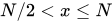
Bach's algorithm produces a number 





Sources and credits
This article is adapted from the Wikipedia article “Bach's algorithm”, written by its contributors and licensed under CC BY-SA 4.0. Fathomly has changed the layout, removed citation markers, navigation and maintenance notices, and adjusted punctuation. This adapted version is shared under the same license. For references, see the original article.
Fathomly is not affiliated with or endorsed by the Wikimedia Foundation. Spotted a problem? Tell us.