Average variable cost
Variable costs of production divided by total output

In economics, average variable cost (AVC) is a firm's variable costs (VC; labour, electricity, etc.) divided by the quantity of output produced (Q):
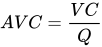
Average variable cost plus average fixed cost equals average total cost (ATC):

A firm would choose to shut down if the price of its output is below average variable cost at the profit-maximizing level of output (or, more generally if it sells at multiple prices, its average revenue is less than AVC). Producing anything would not generate revenue significant enough to offset the associated variable costs; producing some output would add losses (additional costs in excess of revenues) to the costs inevitably being incurred (the fixed costs). By not producing, the firm loses only the fixed costs.
As a result, the firm's short-run supply curve has output of 0 when the price is below the minimum AVC and jumps to output such that 

Sources and credits
This article is adapted from the Wikipedia article “Average variable cost”, written by its contributors and licensed under CC BY-SA 4.0. Fathomly has changed the layout, removed citation markers, navigation and maintenance notices, and adjusted punctuation. This adapted version is shared under the same license. For references, see the original article.
Images, from Wikimedia Commons:
- Shortruncostcurves.jpg by various, Public domain
Fathomly is not affiliated with or endorsed by the Wikimedia Foundation. Spotted a problem? Tell us.
