Automorphic factor
In mathematics, an automorphic factor is a certain type of analytic function, defined on subgroups of SL(2,R), appearing in the theory of modular forms. The general case, for general groups, is reviewed in the article 'factor of automorphy'.
01Definition
An automorphic factor of weight k is a function



An automorphic factor must satisfy:
- For a fixed
is a holomorphic function of
.
- For all
for a fixed real number k.
- For all
, one has
Here,
is the fractional linear transform of
by
.
- If
, then for all
Here, I denotes the identity matrix.
02Properties
Every automorphic factor may be written as

with

The function 
,
while, if
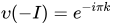
which equals 
03Complex generalization
There exist non-holomorphic automorphic factors of the type

where 


If 


For 


Sources and credits
This article is adapted from the Wikipedia article “Automorphic factor”, written by its contributors and licensed under CC BY-SA 4.0. Fathomly has changed the layout, removed citation markers, navigation and maintenance notices, and adjusted punctuation. This adapted version is shared under the same license. For references, see the original article.
Fathomly is not affiliated with or endorsed by the Wikimedia Foundation. Spotted a problem? Tell us.