Arithmetic progression
Sequence of equally spaced numbers

An arithmetic progression, arithmetic sequence or linear sequence is a sequence of numbers such that the difference from any succeeding term to its preceding term remains constant throughout the sequence. The constant difference is called common difference of that arithmetic progression. For instance, the sequence 5, 7, 9, 11, 13, 15, ... is an arithmetic progression with a common difference of 2.
If the initial term of an arithmetic progression is 



A finite portion of an arithmetic progression is called a finite arithmetic progression and sometimes just called an arithmetic progression. The sum of a finite arithmetic progression is called an arithmetic series.
01History
According to an anecdote of uncertain reliability, in primary school Carl Friedrich Gauss reinvented the formula 


02Sum
The sum of the members of a finite arithmetic progression is called an arithmetic series. For example, consider the sum:

This sum can be found quickly by taking the number n of terms being added (here 5), multiplying by the sum of the first and last number in the progression (here 2 + 14 = 16), and dividing by 2:

In the case above, this gives the equation:

This formula works for any arithmetic progression of real numbers beginning with

Derivation
To derive the above formula, begin by expressing the arithmetic series in two different ways:


Rewriting the terms in reverse order:

Adding the corresponding terms of both sides of the two equations and halving both sides:
![S_{n}={\frac {n}{2}}[2a+(n-1)d].](https://wikimedia.org/api/rest_v1/media/math/render/svg/5623eb3a2ee603f741a2971ba17fe28149c61fec)
This formula can be simplified as:
![{\begin{aligned}S_{n}&={\frac {n}{2}}[a+a+(n-1)d].\\&={\frac {n}{2}}(a+a_{n}).\\&={\frac {n}{2}}({\text{initial term}}+{\text{last term}}).\end{aligned}}](https://wikimedia.org/api/rest_v1/media/math/render/svg/52fc0b115eb3520322146fe69746f34caad8a589)
Furthermore, the mean value of the series can be calculated via: 
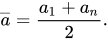
The formula is essentially the same as the formula for the mean of a discrete uniform distribution, interpreting the arithmetic progression as a set of equally probable outcomes.
03Product
The product of the members of a finite arithmetic progression with an initial element a1, common differences d, and n elements in total is determined in a closed expression
![{\begin{aligned}a_{1}a_{2}a_{3}\cdots a_{n}&=a_{1}(a_{1}+d)(a_{1}+2d)\cdots (a_{1}+(n-1)d)\\[1ex]&=\prod _{k=0}^{n-1}(a_{1}+kd)=d^{n}{\frac {\Gamma {\left({\frac {a_{1}}{d}}+n\right)}}{\Gamma {\left({\frac {a_{1}}{d}}\right)}}}\end{aligned}}](https://wikimedia.org/api/rest_v1/media/math/render/svg/d24a39fbd75acbe96af4b836f32044fa9bdca6c5)
where 

This is a generalization of the facts that the product of the progression 


for positive integers 

Derivation
![{\begin{aligned}a_{1}a_{2}a_{3}\cdots a_{n}&=\prod _{k=0}^{n-1}(a_{1}+kd)\\[2pt]&=\prod _{k=0}^{n-1}d\left({\frac {a_{1}}{d}}+k\right)\\[2pt]&=d\left({\frac {a_{1}}{d}}\right)d\left({\frac {a_{1}}{d}}+1\right)d\left({\frac {a_{1}}{d}}+2\right)\cdots d\left({\frac {a_{1}}{d}}+(n-1)\right)\\[2pt]&=d^{n}\prod _{k=0}^{n-1}\left({\frac {a_{1}}{d}}+k\right)=d^{n}{\left({\frac {a_{1}}{d}}\right)}^{\overline {n}}\end{aligned}}](https://wikimedia.org/api/rest_v1/media/math/render/svg/1f92acd108ad06278aa02f12729ff46eb0cbf5a9)
where 
By the recurrence formula 

,
,
so that
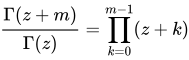
for 
Thus, if 

and, finally,

Examples
- Example 1
Taking the example 


- Example 2
The product of the first 10 odd numbers 
= 654,729,075
04Standard deviation
The standard deviation of any arithmetic progression is
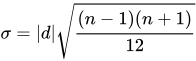
where
05Intersections
The intersection of any two doubly infinite arithmetic progressions is either empty or another arithmetic progression, which can be found using the Chinese remainder theorem. If each pair of progressions in a family of doubly infinite arithmetic progressions have a non-empty intersection, then there exists a number common to all of them; that is, infinite arithmetic progressions form a Helly family. However, the intersection of infinitely many infinite arithmetic progressions might be a single number rather than itself being an infinite progression.
06Amount of arithmetic subsets of length k of the set {1,...,n}
Let 


![\phi (\eta ,\kappa )={\begin{cases}0&{\text{if }}\kappa \mid \eta \\\left(\left[\eta \;({\text{mod }}\kappa )\right]-2\right)\left(\kappa -\left[\eta \;({\text{mod }}\kappa )\right]\right)&{\text{if }}\kappa \not \mid \eta \\\end{cases}}](https://wikimedia.org/api/rest_v1/media/math/render/svg/2b205747ab4840a5349dcd0852dfd3d8b5b630f6)
Then:

As an example, if 


Sources and credits
This article is adapted from the Wikipedia article “Arithmetic progression”, written by its contributors and licensed under CC BY-SA 4.0. Fathomly has changed the layout, removed citation markers, navigation and maintenance notices, and adjusted punctuation. This adapted version is shared under the same license. For references, see the original article.
Images, from Wikimedia Commons:
- Arithmetic progression.svg by Cmglee, CC BY-SA 4.0
- Animated proof for the formula giving the sum of the first integers 1+2+...+n.gif by Vincent Pantaloni, CC BY-SA 4.0
Fathomly is not affiliated with or endorsed by the Wikimedia Foundation. Spotted a problem? Tell us.


