Mean of a function
Formula for the average value of a function over its domain
In calculus, and especially multivariable calculus, the mean of a function is loosely defined as the average value of the function over its domain.
01One-dimensional
In a one-dimensional domain, the mean 
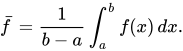
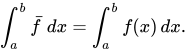
This definition can be justified as follows. The average value 




![[a,b]](https://wikimedia.org/api/rest_v1/media/math/render/svg/9c4b788fc5c637e26ee98b45f89a5c08c85f7935)


Mean value theorem
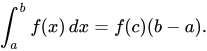
The first mean value theorem for integration guarantees that if 



02Multi-dimensional
In several variables, the mean over a relatively compact domain U in a Euclidean space is defined by

where 

03Non-arithmetic
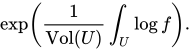
The above generalizes the arithmetic mean to functions. On the other hand, it is also possible to generalize the geometric mean to functions by:
More generally, in measure theory and probability theory, either sort of mean plays an important role. In this context, Jensen's inequality places sharp estimates on the relationship between these two different notions of the mean of a function.
There is also a harmonic average of functions and a quadratic average (or root mean square) of functions.
Sources and credits
This article is adapted from the Wikipedia article “Mean of a function”, written by its contributors and licensed under CC BY-SA 4.0. Fathomly has changed the layout, removed citation markers, navigation and maintenance notices, and adjusted punctuation. This adapted version is shared under the same license. For references, see the original article.
Fathomly is not affiliated with or endorsed by the Wikimedia Foundation. Spotted a problem? Tell us.