Angular distance
Angle between the two sightlines or two objects as viewed from an observer
Angular distance or angular separation is the measure of the angle between the orientation of two straight lines, rays, or vectors, typically in three-dimensional space, or the central angle subtended by the radii through two points on a sphere. When the rays are lines of sight from an observer to two points in space, it is known as the apparent distance or apparent separation.
Angular distance appears in mathematics (in particular geometry and trigonometry) and all natural sciences (e.g., kinematics, astronomy, and geophysics). In the classical mechanics of rotating objects, it appears alongside angular velocity, angular acceleration, angular momentum, moment of inertia and torque.
01Measurement
As an angle, the angular separation is measured using angular units such as degrees or radians, using instruments such as goniometers or optical instruments specially designed to point in well-defined directions and record the corresponding angles (such as telescopes).

02Celestial coordinates
To derive the equation that describes the angular separation of two points located on the surface of a sphere as seen from the center of the sphere, we use the example of two astronomical objects 

![(\alpha _{A},\alpha _{B})\in [0,2\pi ]](https://wikimedia.org/api/rest_v1/media/math/render/svg/a72854b43ba2efa954b8c54fca648a75c441386c)
![(\delta _{A},\delta _{B})\in [-\pi /2,\pi /2]](https://wikimedia.org/api/rest_v1/media/math/render/svg/d268fa7b4324f06ab6279c087cba34c49eb91179)



which is equivalent to:

In the 


![\theta =\cos ^{-1}\left[\sin \delta _{A}\sin \delta _{B}+\cos \delta _{A}\cos \delta _{B}\cos(\alpha _{A}-\alpha _{B})\right]](https://wikimedia.org/api/rest_v1/media/math/render/svg/64a1329637b579886c4532f7b13fa3b8a677927b)
Small angular distance approximation
The above expression is valid for any position of A and B on the sphere. In astronomy, it often happens that the considered objects are really close in the sky: stars in a telescope field of view, binary stars, the satellites of the giant planets of the Solar System, etc. In the case where 

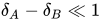
![\cos \theta \approx 1-{\frac {\theta ^{2}}{2}}\approx \sin \delta _{A}\sin \delta _{B}+\cos \delta _{A}\cos \delta _{B}\left[1-{\frac {(\alpha _{A}-\alpha _{B})^{2}}{2}}\right]](https://wikimedia.org/api/rest_v1/media/math/render/svg/8ee6af02268138ebc119b28d1e0cd07f2509ae6c)
meaning

hence
.
Given that 
![\theta \approx {\sqrt {\left[(\alpha _{A}-\alpha _{B})\cos \delta _{A}\right]^{2}+(\delta _{A}-\delta _{B})^{2}}}](https://wikimedia.org/api/rest_v1/media/math/render/svg/c47a3ad07c626e081b63a368006835cb6f0e99e5)
Small angular distance: planar approximation
If we consider a detector imaging a small sky field (dimension much less than one radian) with the 


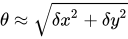
where 
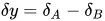
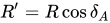
Note that the 


Sources and credits
This article is adapted from the Wikipedia article “Angular distance”, written by its contributors and licensed under CC BY-SA 4.0. Fathomly has changed the layout, removed citation markers, navigation and maintenance notices, and adjusted punctuation. This adapted version is shared under the same license. For references, see the original article.
Images, from Wikimedia Commons:
- Fig angle separation.png by Gaulme, CC BY-SA 4.0
- Fig angle separation planar.png by Gaulme, CC BY-SA 4.0
Fathomly is not affiliated with or endorsed by the Wikimedia Foundation. Spotted a problem? Tell us.


