Almost integer
Any number that is not an integer but is very close to one

In recreational mathematics, an almost integer (or near-integer) is any number that is not an integer but is very close to one. Almost integers may be considered interesting when they arise in some context in which they are unexpected.
01Almost integers relating to the golden ratio and Fibonacci numbers
Some examples of almost integers are high powers of the golden ratio 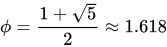
![{\begin{aligned}\phi ^{17}&={\frac {3571+1597{\sqrt {5}}}{2}}\approx 3571.00028\\[6pt]\phi ^{18}&=2889+1292{\sqrt {5}}\approx 5777.999827\\[6pt]\phi ^{19}&={\frac {9349+4181{\sqrt {5}}}{2}}\approx 9349.000107\end{aligned}}](https://wikimedia.org/api/rest_v1/media/math/render/svg/517ac892a0426835ff7e4378faf421aeef1d9fdd)
The fact that these powers approach integers is non-coincidental, because the golden ratio is a Pisot-Vijayaraghavan number.
The ratios of Fibonacci or Lucas numbers can also make almost integers, for instance:


The above examples can be generalized by the following sequences, which generate near-integers approaching Lucas numbers with increasing precision:


As n increases, the number of consecutive nines or zeros beginning at the tenths place of a(n) approaches infinity.
02Almost integers relating to e and π
Other occurrences of non-coincidental near-integers involve the three largest Heegner numbers:


where the non-coincidence can be better appreciated when expressed in the common simple form:


where

and the reason for the squares is due to certain Eisenstein series. The constant 
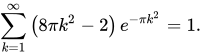
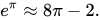
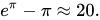
Almost integers that involve the mathematical constants π and e have often puzzled mathematicians. An example is: 







Another example involving these constants is:

Sources and credits
This article is adapted from the Wikipedia article “Almost integer”, written by its contributors and licensed under CC BY-SA 4.0. Fathomly has changed the layout, removed citation markers, navigation and maintenance notices, and adjusted punctuation. This adapted version is shared under the same license. For references, see the original article.
Images, from Wikimedia Commons:
Fathomly is not affiliated with or endorsed by the Wikimedia Foundation. Spotted a problem? Tell us.