Algebraic geometry code
Mathematical linear code
Algebraic geometry codes, often abbreviated AG codes, are a type of linear code that generalize Reed-Solomon codes. The Russian mathematician V. D. Goppa constructed these codes for the first time in 1982.
01History
The name of these codes has evolved since the publication of Goppa's paper describing them. Historically these codes have also been referred to as geometric Goppa codes; however, this is no longer the standard term used in coding theory literature. This is due to the fact that Goppa codes are a distinct class of codes which were also constructed by Goppa in the early 1970s.
These codes attracted interest in the coding theory community because they have the ability to surpass the Gilbert-Varshamov bound; at the time this was discovered, the Gilbert-Varshamov bound had not been broken in the 30 years since its discovery. This was demonstrated by Tfasman, Vladut, and Zink in the same year as the code construction was published, in their paper "Modular curves, Shimura curves, and Goppa codes, better than Varshamov-Gilbert bound". The name of this paper may be one source of confusion affecting references to algebraic geometry codes throughout 1980s and 1990s coding theory literature.
02Construction
In this section the construction of algebraic geometry codes is described. The section starts with the ideas behind Reed-Solomon codes, which are used to motivate the construction of algebraic geometry codes.
Reed-Solomon codes
Algebraic geometry codes are a generalization of Reed-Solomon codes. Constructed by Irving Reed and Gustave Solomon in 1960, Reed-Solomon codes use univariate polynomials to form codewords, by evaluating polynomials of sufficiently small degree at the points in a finite field 
Formally, Reed-Solomon codes are defined in the following way. Let 

![\mathbb {F} _{q}[x]_{<k}:=\left\{f\in \mathbb {F} _{q}[x]:\deg f<k\right\}](https://wikimedia.org/api/rest_v1/media/math/render/svg/c5bfb18b219329b5475ed4a254fd1a78e009016b)

![RS(q,n,k)=\left\{\left(f(\alpha _{1}),f(\alpha _{2}),\dots ,f(\alpha _{n})\right):f\in \mathbb {F} _{q}[x]_{<k}\right\}\subseteq \mathbb {F} _{q}^{n}.](https://wikimedia.org/api/rest_v1/media/math/render/svg/f519272f706d6d3f7a58d6586738ff6121b27f2d)
Codes from algebraic curves
Goppa observed that 
![\mathbb {F} _{q}[x]_{<k}](https://wikimedia.org/api/rest_v1/media/math/render/svg/52ce5d010b875652e08543464484d1b328905866)

With this idea in mind, Goppa looked toward the Riemann-Roch theorem. The elements of a Riemann-Roch space are exactly those functions with pole order restricted below a given threshold, with the restriction being encoded in the coefficients of a corresponding divisor. Evaluating those functions at the rational points on an algebraic curve 

However, because the parameters of algebraic geometry codes are connected to algebraic function fields, the definitions of the codes are often given in the language of algebraic function fields over finite fields. Nevertheless, it is important to remember the connection to algebraic curves, as this provides a more geometrically intuitive method of thinking about AG codes as extensions of Reed-Solomon codes.
Formally, algebraic geometry codes are defined in the following way. Let 




03Decoding
Some algebraic geometry codes can be decoded using algorithms based on the Berlekamp-Massey-Sakata algorithm. Shojiro Sakata introduced this algorithm as an extension of the Berlekamp-Massey algorithm to multidimensional arrays. In particular, one-point algebraic geometry codes can be decoded efficiently using the Berlekamp-Massey-Sakata algorithm, and later variants have been developed for multipoint codes from algebraic curves.
04Examples
Reed-Solomon codes
One can see that

where 

One-point Hermitian codes
The Hermitian curve is given by the equation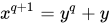

The Riemann-Roch space of the Hermitian function field is given in the following statement. For the Hermitian function field 




With that, the one-point Hermitian code can be defined in the following way. Let 
Let 

The one-point Hermitian code 

Sources and credits
This article is adapted from the Wikipedia article “Algebraic geometry code”, written by its contributors and licensed under CC BY-SA 4.0. Fathomly has changed the layout, removed citation markers, navigation and maintenance notices, and adjusted punctuation. This adapted version is shared under the same license. For references, see the original article.
Fathomly is not affiliated with or endorsed by the Wikimedia Foundation. Spotted a problem? Tell us.