Adaptive value

The adaptive value represents the combined influence of all characters which affect the fitness of an individual or population.
01Definition
Adaptive value is an essential concept of population genetics. It represents usefulness of a trait that can help an organism to survive in its environment. This heritable trait that can help offspring to cope with the new surrounding or condition is a measurable quantity. Measuring adaptive value increases our understanding of how a trait helps an individual's or population's chances of survival in a particular set of conditions.
02Measurement
The adaptive value can be measured by contribution of an individual to the gene pool of their offspring. The adaptive values are approximately calculated from the rates of change in frequency and mutation-selection balance.
03Examples
- Avoiding Predators Some plants use indirect plant defenses to protect themselves against their herbivorous consumers. One of defensive mechanism that plants employ is to release volatile chemicals when herbivores are feeding from them. The odor of volatile chemical attracts carnivores' attention, and they get rid of herbivores by eating them.
- Sexual Reproduction Advantages Sexual mimicry is common among animals. Male cuttlefishes uses this strategy to gain advantage over other males competitor. They mimic female cuttlefish's marking to fool guarding male and fertilize their females. This strategy has more success rate than normal courtship.
Sources and credits
This article is adapted from the Wikipedia article “Adaptive value”, written by its contributors and licensed under CC BY-SA 4.0. Fathomly has changed the layout, removed citation markers, navigation and maintenance notices, and adjusted punctuation. This adapted version is shared under the same license. For references, see the original article.
Images, from Wikimedia Commons:
- Evolution sm.png by National Human Genome Research Institute's Talking Glossary, Public domain
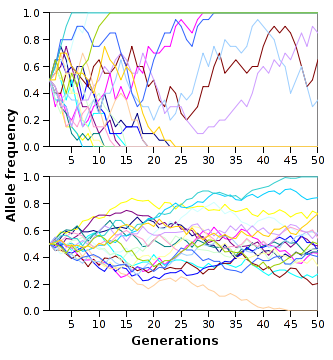
- Allele-frequency.png by The original uploader was Esurnir at English Wikipedia., CC BY-SA 3.0
Fathomly is not affiliated with or endorsed by the Wikimedia Foundation. Spotted a problem? Tell us.
