Adaptive system
System that can adapt to the environment
An adaptive system is a set of interacting or interdependent entities, real or abstract, forming an integrated whole that together are able to respond to environmental changes or changes in the interacting parts, in a way analogous to either continuous physiological homeostasis or evolutionary adaptation in biology. Feedback loops represent a key feature of adaptive systems, such as ecosystems and individual organisms; or in the human world, communities, organizations, and families. Adaptive systems can be organized into a hierarchy.
Artificial adaptive systems include robots with control systems that utilize negative feedback to maintain desired states.
01The law of adaptation
The law of adaptation may be stated informally as:
Every adaptive system converges to a state in which all kind of stimulation ceases.
Formally, the law can be defined as follows:
Given a system 

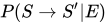

Let 


- -
- -


Thus, for each instant 

02Benefit of self-adjusting systems
In an adaptive system, a parameter changes slowly and has no preferred value. In a self-adjusting system though, the parameter value “depends on the history of the system dynamics”. One of the most important qualities of self-adjusting systems is its “adaptation to the edge of chaos” or ability to avoid chaos. Practically speaking, by heading to the edge of chaos without going further, a leader may act spontaneously yet without disaster. A March/April 2009 Complexity article further explains the self-adjusting systems used and the realistic implications. Physicists have shown that adaptation to the edge of chaos occurs in almost all systems with feedback.
03Practopoietic theory
According to practopoietic theory, creation of adaptive behavior involves special, poietic interactions among different levels of system organization. These interactions are described on the basis of cybernetic theory in particular, good regulator theorem. In practopoietic systems, lower levels of organization determine the properties of higher levels of organization, but not the other way around. This ensures that lower levels of organization (e.g., genes) always possess cybernetically more general knowledge than the higher levels of organization, knowledge at a higher level being a special case of the knowledge at the lower level. At the highest level of organization lies the overt behavior. Cognitive operations lay in the middle parts of that hierarchy, above genes and below behavior. For behavior to be adaptive, at least three adaptive traverses are needed.
Sources and credits
This article is adapted from the Wikipedia article “Adaptive system”, written by its contributors and licensed under CC BY-SA 4.0. Fathomly has changed the layout, removed citation markers, navigation and maintenance notices, and adjusted punctuation. This adapted version is shared under the same license. For references, see the original article.
Fathomly is not affiliated with or endorsed by the Wikimedia Foundation. Spotted a problem? Tell us.


