Action (physics)
Physical quantity of dimension energy × time
In physics, action is a scalar quantity that describes how the balance of kinetic versus potential energy of a physical system changes with trajectory. Action is significant because it is an input to the principle of stationary action, an approach to classical mechanics that is simpler for multiple objects. Action and the variational principle are used in Feynman's formulation of quantum mechanics and in general relativity. For systems with small values of action close to the Planck constant, quantum effects are significant.
In the simple case of a single particle moving with a constant velocity (thereby undergoing uniform linear motion), the action is the momentum of the particle times the distance it moves, added up along its path; equivalently, action is the difference between the particle's kinetic energy and its potential energy, times the duration for which it has that amount of energy.
More formally, action is a mathematical functional which takes the trajectory (also called path or history) of the system as its argument and has a real number as its result. Generally, the action takes different values for different paths. Action has dimensions of energy × time or momentum × length, and its SI unit is joule-second (like the Planck constant h).
01Introduction
Introductory physics often begins with Newton's laws of motion, relating force and motion; action is part of a completely equivalent alternative approach with practical and educational advantages. However, the concept took many decades to supplant Newtonian approaches and remains a challenge to introduce to students.
Simple example
For a trajectory of a ball moving in the air on Earth the action is defined between two points in time, t1 and t2 as the kinetic energy (KE) minus the potential energy (PE), integrated over time.

The kinetic energy of a ball of mass m is 1/2mv2 where v is the velocity of the ball; the potential energy is mgx where g is the acceleration due to gravity and x its height. Then the action between t1 and t2 is

Planck's quantum of action
The Planck constant, written as h, is the quantum (the minimal possible amount) of action. It is related to the quantum of angular momentum, ħ, by the relation ħ = h/2π. These constants have units of energy times time. They appear in all significant quantum equations, such as the uncertainty principle and the de Broglie wavelength. Whenever the value of the action approaches the Planck constant, quantum effects are significant.
02History
Pierre Louis Maupertuis and Leonhard Euler working in the 1740s developed early versions of the action principle. Joseph Louis Lagrange clarified the mathematics when he invented the calculus of variations. William Rowan Hamilton made the next big breakthrough, formulating Hamilton's principle in 1853. Hamilton's principle became the cornerstone for classical work with different forms of action until Richard Feynman and Julian Schwinger developed quantum action principles.
03Definitions
Expressed in mathematical language, using the calculus of variations, the evolution of a physical system (that is, how the system actually progresses from one state to another) corresponds to a stationary point (usually, a minimum) of the action. Action has the dimensions of [energy] × [time], and its SI unit is joule-second, which is identical to the unit of angular momentum.
Several different definitions of "the action" are in common use in physics. The action is usually an integral over time. However, when the action pertains to fields, it may be integrated over spatial variables as well. In some cases, the action is integrated along the path followed by the physical system.
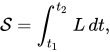
The action is typically represented as an integral over time, taken along the path of the system between the initial time and the final time of the development of the system:
Action (functional)
Most commonly, the term is used for a functional 𝒮 which takes a function of time and (for fields) space as input and returns a scalar. In classical mechanics, the input function is the evolution q(t) of the system between times t1 and t2, where q represents the generalized coordinates. The action 𝒮[q(t)] is defined as the integral of the Lagrangian L for an input evolution between the two times:
![{\mathcal {S}}[\mathbf {q} (t)]=\int _{t_{1}}^{t_{2}}L{\bigl (}\mathbf {q} (t),{\dot {\mathbf {q} }}(t),t{\bigr )}\,dt,](https://wikimedia.org/api/rest_v1/media/math/render/svg/fa39a89ac5ecfb8944e3eb9f0d2a298e7c6b0ee3)
Abbreviated action (functional)
In addition to the action functional, there is another functional called the abbreviated action. In the abbreviated action, the input function is the path followed by the physical system without regard to its parameterization by time. For example, the path of a planetary orbit is an ellipse, and the path of a particle in a uniform gravitational field is a parabola; in both cases, the path does not depend on how fast the particle traverses the path.
The abbreviated action 𝒮0 (sometimes written as W) is defined as the integral of the generalized momenta,
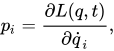

Hamilton's characteristic function
When the total energy E is conserved, the Hamilton-Jacobi equation can be solved with the additive separation of variables:

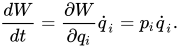
This can be integrated to give

which is just the abbreviated action.
Action of a generalized coordinate
A variable Jk in the action-angle coordinates, called the "action" of the generalized coordinate qk, is defined by integrating a single generalized momentum around a closed path in phase space, corresponding to rotating or oscillating motion:
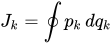
The corresponding canonical variable conjugate to Jk is its "angle" wk, for reasons described more fully under action-angle coordinates. The integration is only over a single variable qk and, therefore, unlike the integrated dot product in the abbreviated action integral above. The Jk variable equals the change in Sk(qk) as qk is varied around the closed path. For several physical systems of interest, Jk is either a constant or varies very slowly; hence, the variable Jk is often used in perturbation calculations and in determining adiabatic invariants. For example, they are used in the calculation of planetary and satellite orbits.
Single relativistic particle
When relativistic effects are significant, the action of a point particle of mass m travelling a world line C parametrized by the proper time τ is
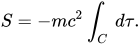
If instead, the particle is parametrized by the coordinate time t of the particle and the coordinate time ranges from t1 to t2, then the action becomes
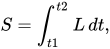

where gμν is the metric tensor ≈ (−c2,1,1,1).
Sources and credits
This article is adapted from the Wikipedia article “Action (physics)”, written by its contributors and licensed under CC BY-SA 4.0. Fathomly has changed the layout, removed citation markers, navigation and maintenance notices, and adjusted punctuation. This adapted version is shared under the same license. For references, see the original article.
Fathomly is not affiliated with or endorsed by the Wikimedia Foundation. Spotted a problem? Tell us.