Accumulation function
In actuarial mathematics, the accumulation function a(t) is a function of time t expressing the ratio of the value at time t (future value) and the initial investment (present value). It is used in interest theory.
Thus a(0) = 1 and the value at time t is given by:

where the initial investment is

For various interest-accumulation protocols, the accumulation function is as follows (with i denoting the interest rate and d denoting the discount rate):
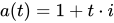
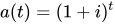
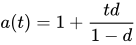

In the case of a positive rate of return, as in the case of interest, the accumulation function is an increasing function.
01Variable rate of return
The logarithmic or continuously compounded return, sometimes called force of interest, is a function of time defined as follows:

which is the rate of change with time of the natural logarithm of the accumulation function.
Conversely:

reducing to

for constant 
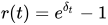
The effective annual percentage rate at any time is:
Sources and credits
This article is adapted from the Wikipedia article “Accumulation function”, written by its contributors and licensed under CC BY-SA 4.0. Fathomly has changed the layout, removed citation markers, navigation and maintenance notices, and adjusted punctuation. This adapted version is shared under the same license. For references, see the original article.
Fathomly is not affiliated with or endorsed by the Wikimedia Foundation. Spotted a problem? Tell us.
